Skills matrix: helping a Product Manager grow
- Role
- Manager of the Product Manager
- Team
- The Product Manager and me
- Duration
- Since December 2025
- Skills
- Team management · Mentoring
A Product Manager on my team saw themselves further along than our skills matrix showed. We turned that gap into a growth plan, which we track every month.
- Starting point
- On the product team of an EdTech platform, “becoming senior” had no shared criteria. So the Product Manager on my team and I did not see their growth the same way.
- What I did
- To give us shared criteria, I built a skills matrix and reviewed it with the Product Manager. In a one-on-one, we worked out together where they stood and chose two focus areas. These became OKRs (objectives and key results), reviewed at a monthly check-in.
- Impact
- The Product Manager joined an AI project, one of the two focus areas of their plan. From February to April 2026, with the Product Designer : the person who designs the product’s screens and how people use them, based on what users need., they ran the client interviews and surveys for the AI speaking role-plays (project 01 in this portfolio).
A gap to name
On the team, “becoming senior” had never been defined, either for the Product Manager or for me, their manager. The two of us judged their growth, each by our own standards.
To help them grow, we first had to agree on one thing: where they stood. Without written criteria, a gap between our two views stayed invisible.
A framework to talk about it
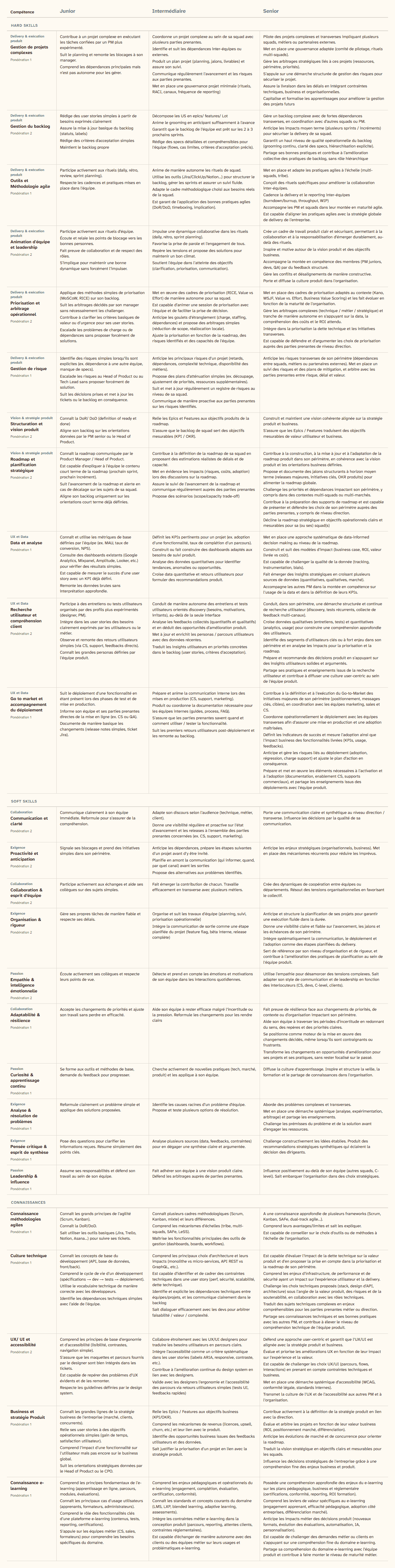
In December 2025, I built a skills matrix. For each skill, it describes what you can see someone do at three levels, from junior to senior.
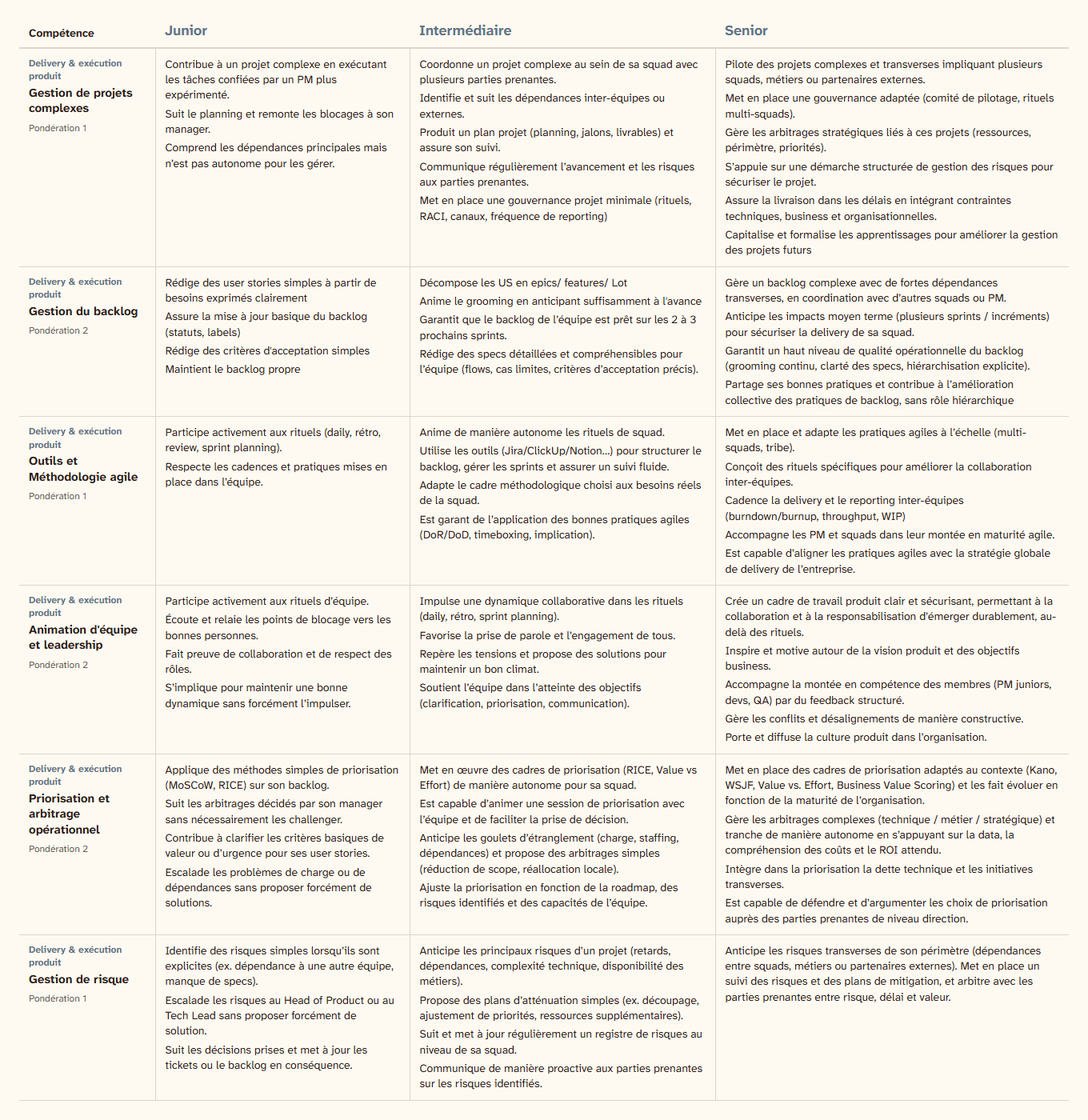
Before using it, I reviewed it with the Product Manager. That way, we had the same criteria in front of us before discussing their growth. Here is one block of the matrix.
One conversation to see where we stood
In January 2026, the Product Manager and I went through the matrix in a one-on-one, skill by skill. They saw themselves further along than the matrix showed. We talked it through based on observed behaviors.
We agreed on two focus areas. The first brings them closer to users and to the field; the second takes them further into AI applied to product management.
A check-in every month
These two focus areas became OKRs, including one for personal development. We have been reviewing them every month since.
What has changed
From February to April 2026, the Product Manager went out to meet clients, on the AI speaking role-plays, project 01 in this portfolio. With the Product Designer, they ran the interviews and the survey that reordered the next steps of the project.
What I took from it
Describe each level by what you can see someone do. A sentence that describes a behavior can be checked. The exercise made me pin down my own expectations before applying them to someone else.
Name the gap, then turn it into a plan. With criteria we had reviewed together, we could compare our two views on facts. The gap became the starting point of a plan we share.
Track the plan every month. Because it is tied to OKRs, the plan is on the agenda of every monthly check-in. It stays part of everyday work.
Going further
How the matrix is structured
- Three levels: junior, intermediate, senior.
- Core skill areas: product Delivery : taking what the team builds all the way to release, on schedule. and execution, product vision and strategy, UX (user experience) and data.
- Soft skills: collaboration, high standards, passion.
- A weighting for each skill.
- Prerequisites to meet before each level.
- A framework rooted in EdTech work: learning design, trade-offs between profitability and educational value, dashboards for teachers.
One row across its three levels: backlog management
- Junior: writes simple User stories : short descriptions of a need, written from the user’s point of view, telling the team what to build..
- Intermediate: breaks work down into Epics : pieces of work too big to ship in one go, which the team splits into smaller ones. and runs Grooming : the meeting where the team reviews and clarifies what it will build next, and estimates the effort..
- Senior: manages a Backlog : the list, ranked by priority, of what the team plans to build. with heavy cross-team dependencies.
The full grid